
While most desktop printing uses plastic, the world of metal 3D printing is where the technology is revolutionizing major industries. This guide covers how it works, the materials used, its key advantages, and how you can experiment with metal parts yourself.
Key Takeaways
- Industrial metal 3D printing primarily uses Powder Bed Fusion (DMLS/SLM) to fuse microscopic metal particles with high-powered lasers.
- It enables generative design, creating impossible geometries that are lighter and stronger than traditionally manufactured parts.
- Common materials include Titanium, Stainless Steel, and Inconel (used heavily in aerospace and medical fields).
- Hobbyists can achieve metal-like results at home using metal-filled filaments or lost-wax casting.
The Core Technology: Powder Bed Fusion (DMLS/SLM)
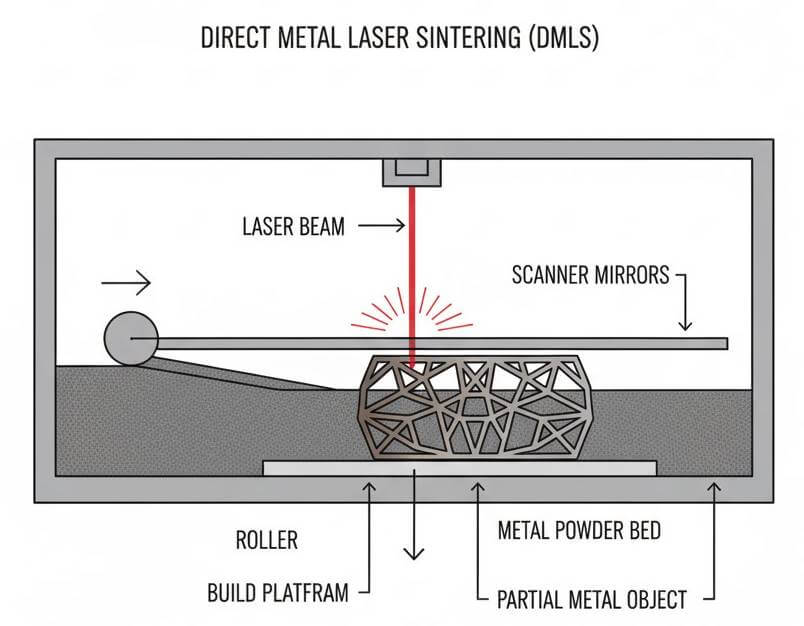
The most common technology is Direct Metal Laser Sintering (DMLS) or Selective Laser Melting (SLM). The process is fascinating, building fully dense parts from metal powder, layer by microscopic layer.
- A roller spreads a paper-thin layer of fine metal powder across a build platform.
- A high-powered laser, guided by the 3D model, selectively melts and fuses the powder particles together in a specific pattern.
- The build platform lowers slightly, and the roller adds a fresh layer of powder on top.
- The process repeats thousands of times, fusing each new layer to the one below it, until the solid metal part is complete inside the bed of powder.
What Metals Can Be Printed?
A wide range of engineering-grade metals can be used, each chosen for its specific properties. Here is a breakdown of the most common industrial metals used in 3D printing today:
| Metal Type | Key Properties | Primary Industry Use |
|---|---|---|
| Titanium | Incredibly strong, lightweight, biocompatible | Aerospace components, Medical implants |
| Stainless Steel | Strong, ductile, highly corrosion-resistant | Industrial hardware, Tooling, Prototyping |
| Aluminum Alloys | Lightweight, excellent thermal conductivity | Automotive parts, Heat exchangers |
| Inconel (Nickel Alloy) | Maintains extreme strength at high temperatures | Rocket engines, Jet turbines |
The "Why": Key Advantages of Metal Printing
Impossible Geometries & Generative Design
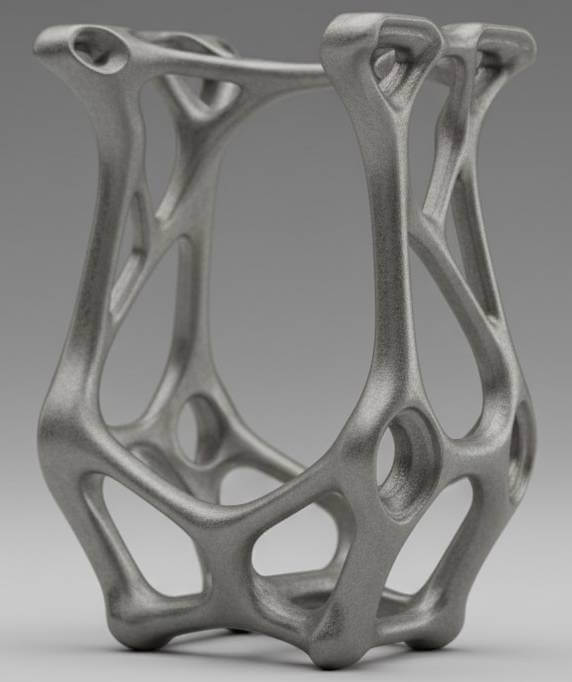
This is the biggest advantage. Metal printing can create shapes that are physically impossible to make with traditional methods. Engineers use "generative design" software that mimics nature's evolutionary approach—like the structure of bone—to create parts that are both incredibly strong and skeletal in appearance. This allows for things like complex internal cooling channels inside a turbine blade or a medical implant with a porous surface that bone can grow into.
Part Consolidation & Increased Reliability
An assembly that previously required 20 individual parts (welds, bolts, brackets) can be redesigned and printed as a single, complex piece. This reduces weight, simplifies the supply chain, and eliminates potential points of failure, making the final component more reliable.
A Look at Other Technologies: Binder Jetting
While Powder Bed Fusion is common, Metal Binder Jetting is a faster, emerging technology. Instead of a laser, an inkjet-style print head deposits a liquid binding agent onto the metal powder, "gluing" the layers together. The part is then removed and put into a furnace (sintered) where the binder is burned away and the metal particles fuse. It's often faster and cheaper for larger batches, but the parts are typically not as strong as DMLS parts.
The Major Limitations
While powerful, the technology has limitations that keep it focused on high-value applications:
- Cost: The machines can cost hundreds of thousands of dollars, and the specialized metal powders are extremely expensive.
- Speed: The process is much slower than traditional mass-production methods like casting.
- Post-Processing: Parts often require heat treatment, and removing the dense metal support structures is a difficult, labor-intensive process.
Printing with premium materials?
Metal-filled filaments and specialty resins cost significantly more than standard PLA. Don't lose money on your projects.
Calculate Your Profit MarginMetal Printing for Hobbyists
While you can't run a DMLS machine at home, there are clever ways to create metal parts. Many of the finishing techniques discussed in our Pro Tips & Hacks guide are essential for these methods.
- Metal-Filled Filaments: Best for creating strong, functional parts without needing your own foundry. Requires a mail-out service for the final sintering process.
- Lost-Wax Casting: Best for creating highly detailed decorative or functional parts (like jewelry or custom brackets) if you have a workshop setup for metal casting.
- Cold Casting: Best for purely cosmetic props and replicas where you want the look, weight, and cold feel of metal without the actual strength.